Validation & Diagnostics
param-lsp provides real-time validation of parameter values, types, and constraints with immediate error feedback.
Type Validation
Catch type mismatches before runtime:
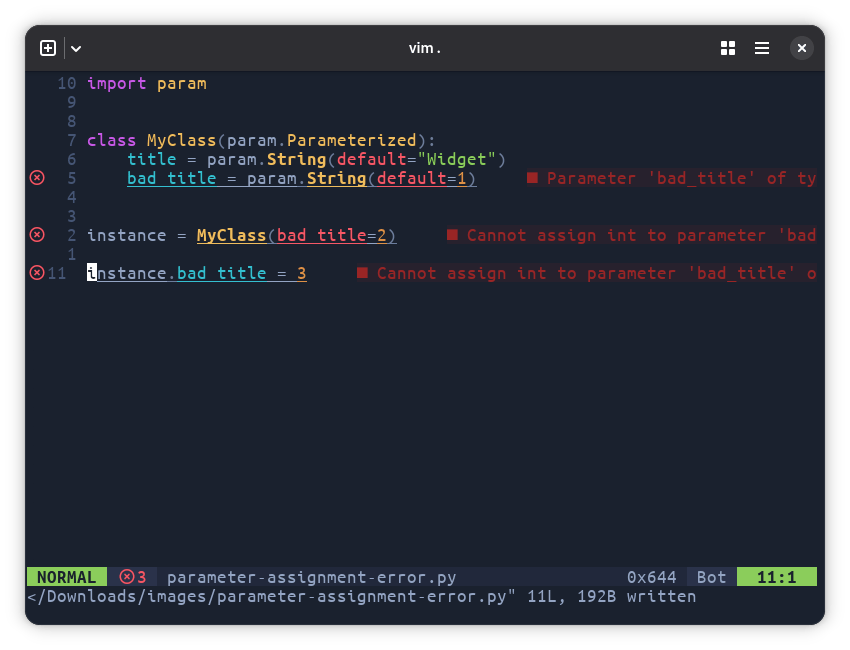
Supported type validations:
- String: Text values, optional regex patterns
- Integer: Whole numbers with optional bounds
- Number: Numeric values (int/float) with optional bounds
- Boolean: True/False values
- List: List objects with optional item type validation
- Dict: Dictionary objects
- Tuple: Tuple objects with optional element validation
Bounds Checking
Immediate feedback when parameter values violate bounds:
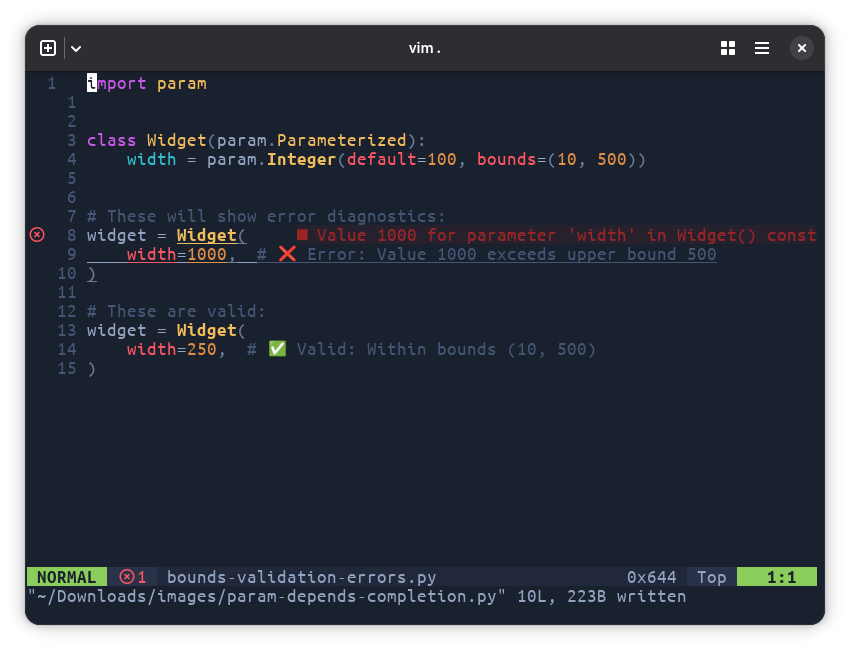
Error diagnostics with red squiggly lines under invalid values and error tooltips
import param

class Widget(param.Parameterized):
    width = param.Integer(default=100, bounds=(10, 500))
    opacity = param.Number(default=1.0, bounds=(0.0, 1.0))

# These will show error diagnostics:
widget = Widget(
    width=1000,    # ❌ Error: Value 1000 exceeds upper bound 500
    opacity=1.5    # ❌ Error: Value 1.5 exceeds upper bound 1.0
)

# These are valid:
widget = Widget(
    width=250,     # ✅ Valid: Within bounds (10, 500)
    opacity=0.8    # ✅ Valid: Within bounds (0.0, 1.0)
)
Error messages include:
- Specific bound violation details
- Expected range information
- Suggested valid values
Selector Validation
Validation for parameter choices:
import param

class Theme(param.Parameterized):
    style = param.Selector(
        default="light",
        objects=["light", "dark", "auto"]
    )
    size = param.Selector(
        default="medium",
        objects=["small", "medium", "large"]
    )

# This will show error diagnostics:
theme = Theme(
    style="blue",      # ❌ Error: 'blue' not in allowed objects
    size="tiny"        # ❌ Error: 'tiny' not in allowed objects
)

# This is valid:
theme = Theme(
    style="dark",      # ✅ Valid: In allowed objects
    size="large"       # ✅ Valid: In allowed objects
)
Selector features:
- Choice validation against allowed objects
- Suggestions for similar valid choices
- Case-sensitive matching
- Support for mixed-type choices
List and Dict Validation
Complex type validation for collections:
import param

class DataConfig(param.Parameterized):
    tags = param.List(
        default=["tag1", "tag2"],
        item_type=str  # Each item must be a string
    )

    metadata = param.Dict(
        default={"version": "1.0", "author": "user"}
    )

    coordinates = param.Tuple(
        default=(0, 0),
        length=2  # Must have exactly 2 elements
    )

# These will show error diagnostics:
config = DataConfig(
    tags=["tag1", 123],        # ❌ Error: Item 123 is not a string
    metadata="not-a-dict",     # ❌ Error: Expected dict, got string
    coordinates=(1, 2, 3)      # ❌ Error: Expected 2 elements, got 3
)